Welcome to my blog. If you're addicted to books, like I am, then you've come to the right place. I mostly write about books and my experiences reading them. These are very personal book reviews. (If you can even call them book reviews...) I’m a true believer that none of us lives in a vacuum. When you read a book, watch a movie, listen to a song, etc., you absorb that art form into your life experience, and it changes you. But you also change it, because no two people see anything the same way. The way I interpret a novel may be totally different from the way you will. It’s still the same novel, but the meaning for each of us is unique. Once you express that meaning, it changes the art. So these posts are about how these books fit into my life. I’d love to hear how they fit into yours. Please make comment and share your experience.
Showing posts with label WWII Stories. Show all posts

Wednesday, March 21, 2012

Review of Shanghai Girls by Lisa See

Sister.

If you have a sister, that word probably brings a few emotions to mind.  Sister relationships are fascinating and multi-faceted.  They can be supportive and loving or antagonistic and critical.  And they can be all at once. 

I’m thankful that I have a fabulous relationship with my sister.  I can call my sister and talk for hours.  Back when we were both stay-at-home moms, we often called each other 3-4 times a day, for all kinds of reasons, from mundane to profound.  I trust her completely.  I know she’s there for me, no matter what.  It’s a comfort to really understand the depth of your relationships, in your heart, in your mind, in your gut. 

But every relationship has its boundaries.  They all have places where you don’t go.   My two closest girlfriends each have sisters with whom they are extremely close and yet, there are some things they just don’t talk about with each other.  Even my sister and I, for all the closeness and supportiveness in our relationship, have boundaries, too.  I imagine all relationships have them, no matter how close or significant. 


Shanghai Girls by Lisa See is a story about the Chin sisters, Pearl and May.  Their relationship is as complex as any sister relationship, with love and support and betrayal and heartbreak, and quite a lot of antagonism.    It begins in 1937 Shanghai.  We follow their lives through the Japanese invasion and their escape to America, to find them begrudgingly settled in San Francisco during WWII and afterwards.  It spans several decades in the characters’ lives, and through many life stages.  Even with a rich historical and cultural backdrop, the sister and family dynamics are what I found most interesting throughout this book. 

The Chin sisters’ relationship is strewn with jealousy.  Each felt that the other one had it better than she did, or one was the parents’ favorite, or had the better husband or the better job, or one sacrificed more than the other…it got a little annoying a few times because I just couldn’t relate.  I don’t see my own sister the way Pearl and May see theirs—with as much resentment as love.  This did however, give the BABBs much to discuss---as we all have family and everyone can identify with a family story.  Mostly I pitied the Chin sisters because all that hurt and resentment held them back.

Shanghai Girls is a thoroughly enjoyable read and very good historical fiction, even though the subject material and setting are often disturbing and depressing. 

Ratings  (For an explanation of my rating factors, please visit the Rating System Key page.)


Crack Factor – 8.0. 

Tears Shed Factor –  N/A. There’s plenty of drama in this book but I didn’t find it emotional, although I imagine many people would.

Distraction Factor – 9.25.  Shanghai Girls is a haunting tale.  Just like in See’s Snow Flower and the Secret Fan, (one of my favorite books) there are images from this story that I’ll never forget. 

Enrichment Factor – 9.0.  Immigrant stories are frequently stories of hardship and discrimination.  I really wonder if there was every any group that came here without it.  The Chinese immigrants in this story had it pretty bad; they maneuvered through the anti-Japanese sentiments during WWII and then the anti-communist rampage right afterwards.  I love fiction that gives me new knowledge and understanding of history and culture.  This time and place was something I’d never studied before.

PeopleFactor – 8.5. See wrote the book in the first person.  All the characters and events are narrated by Pearl, which definitely adds some limitation as you can’t always get inside the heads of the other characters.  I don’t see that as a problem here, because through Pearl’s eyes, the reader gets a very good sense of all the characters and See crafts them like onions, with layers that Pearl peels away over time to reveal just how complex each one is.  As soon as you think you’ve got them all figured out, See gives us a little more insight and…You’ll change your mind about everybody over and over again.  It made for a more interesting read because the characters and their relationships evolve so much over time. 

Story Telling Factor – 8.5. The majority of the BABBs had a couple of complaints about this book: 1) It ends very abruptly, and 2) they didn’t always like how See turned the plot. On a whole, however, I found See’s plot twists quite pivotal and necessary to keep the pace of the story going and bring certain characters to their destinies and certain plot lines to their climaxes.  But I do have to admit the ending did tick me off.  Apparently See had to set it up for the sequel:  Finding Joy.  Why write one book, when you can sell two at twice the price?

Writing Skills Factor – 8.5.  See’s writing is raw.  It’s very simple and clear and to the point.  That rawness adds to the distraction factor as well.  She doesn’t leave out the nasty and upsetting details.

Bad Ass Babe Factor –  I’m abstaining from this rating.  I didn’t really like Pearl or May that much as people, even though they were well developed characters.  In the Bad Ass Babe arena, however, Pearl gets points for sheer endurance and their mother gets Mama Bear points. 

Total Rating: 8.625


Wednesday, March 7, 2012

Review of Blackout by Connie Willis

There is nothing like an incredibly long business trip to help you catch up on your reading.  I just recently returned from a trip to the UK and while I was there I was able to finish three books.  In fairness, I was mostly done with two of them, but it still felt good to cross three off the list.  I found it incredibly interesting, however, to be finishing Blackout by Connie Willis while I was in London, because much of it is set in London, so that made it fun to be walking the streets in which part of the story takes place.

Big Ben & The Houses of Parliament, Feb 2012-JJWBaker
Connie Willis is an award winning Sci-fi author that I first learned about from Grigg, the sci-fi loving character in The Jane Austen Book Club by Karen Joy Fowler.  I trust his recommendations, having read two Ursula LeGuin books because of him, and Connie Willis was one of his favorite authors.  Turns out, she’s also won the Hugo award a few times, among other awards.  Blackout is the first volume of a two volume novel, All Clear is the second volume and together they won the Hugo for best novel in 2011, so I figured they were worth a look.

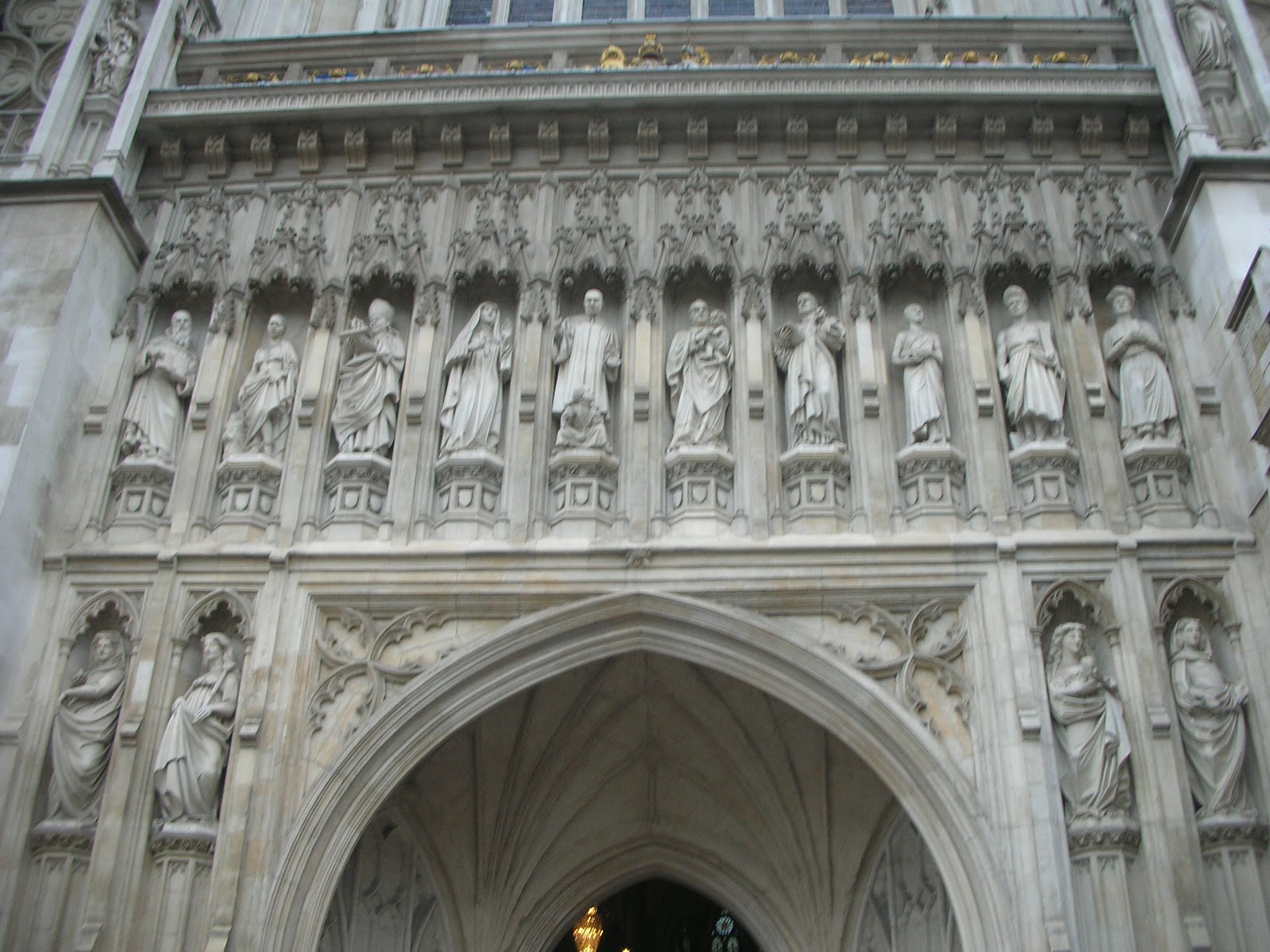
Westminster Abbey, Feb 2012 - JJWBAKER

Blackout is the story of three historians from Oxford, England in 2060.  In Willis’ world, time travel is possible and historians regularly travel back in time to observe history as it is happening.  They have quite a complex theory about this, and genuinely believe that they cannot affect history as long as they stay clear of “divergence points,” which are critical times in history when a small change could have a big outcome.  These three historians are studying what seem to be mundane aspects of the war.  One is working as a shop girl in London during the Blitz, to study how Londoners cope during the air raids.  One is a maid in the countryside studying the evacuated children.  And the third is posing as an American reporter, studying the evacuation of Allied soldiers from Dunkirk, France.  One by one these historians encounter unforeseen problems and slowly come to the realization that despite the time travel theory, they may have altered the course of the war and their way back to the future may no longer exist. 
Fountain in Trafalgar Square, Feb 2012-JJWBaker

It seems I’ve read a good many World War II books recently.  I hadn’t realized it until one of the BABBs was complaining that we’d picked too many WWII books and she hates that time period.  Consequently I’ve added it as a label for the blog because I do have quite a few WWII stories in here.   What I found particularly interesting about this novel, however, is that all 3 of these time travelers are studying areas of history that you don’t normally hear about.  I’d never thought much before about quotidian life for Londoners during the Blitz, sleeping in Tube stations and the camaraderie that would engender.  Same thing for the life of a maid taking care of evacuated children.  They were unique perspectives on the war, and it was a nice change to get a new perspective.    
The London Eye, Feb 2012-JJWBAKER

While there is a lot of action in this story, it didn’t leave much room for serious character development.  Honestly I didn’t really miss it until I started writing the review…  The secondary characters I found more interesting than the three main time travelers, which make sense in retrospect as the time travelers are forced to blend into their surroundings, so aside from their inner monologues, you don’t see them doing many unique things to set themselves apart from their subjects.  The WWII contemporaries, however, are quite interesting:  The elderly boat captain with delusions of grandeur, determined to do his part in the Dunkirk evacuation, the mischievous Ralph & Binnie, evacuee children wreaking havoc on their country safe house, and the eccentric Londoners trapped in the Tube station during air raids with their attempt to put on a stage play underground to pass the time. 
Liberty Department Store, London, Feb 2012-JJWBAKER
This is a pretty good page turner, but at some point, I did feel like the story was dragging a bit.  About ¾ of the way through the novel, I thought—all of these characters know something is wrong, but they didn’t seem to be moving on to the next part—I felt like, let’s get on with them finding each other and fixing it already and it seemed like it took forever to get to that point.
Westminster Abbey, Feb 2012, JJWBAKER
One thing I really enjoyed about the time travel perspective was how these historians are constantly trying to blend in and fit the WWII roll they are playing.  Imagine if part of your job entailed pretending to be someone else and do her job.  It’s like these historians are doing triple duty:  1-the historical roll, 2-the historical job and 3-the historian, and they have to do it in a war zone... of course the stress catches up to each of them at different points.   They have to call on their historical and cultural knowledge and sometimes common sense or modern ideas trip them up because they forget that something hasn’t been invented in the 1940s, or they have to recall historical dates or bombing data and then worry that their actions look suspicious and they might be hauled in for suspicion of being a German spy.  And in many ways they are spies, just from the future.  It made for added complexity in the story.    

I think this is Whitehall, but I really don't remember. London Feb 2012 - JJWBAKER
Overall, this was an enjoyable, entertaining read, I’d even go so far as to categorize it as historical fiction as well as sci-fi. 

Sunday, January 22, 2012

Review of Things We Couldn’t Say by Diet Eman with James Schaap

Usually when I finish a non-fiction book, I’m a little awed.  This makes sense if you think about it, because nobody is going to take the time to write a story about something boring.  Writers pick the interesting and amazing stuff, the suspenseful and scary stuff.  It may even be heroic and humbling.  Diet Eman’s stories of the German occupied Netherlands during WWII are all that and more.  In Things We Couldn’t Say, she tells of her life as a young woman in the Nazi occupied Netherlands and how she and her fiancĂ©e, Hein Sietsma, and their friends worked to hide Jews with the Dutch underground resistance. 

Things We Couldn't Say   -     
        By: Diet Eman, James Schaap

Eman is a resident of Grand Rapids, which makes her my neighbor.  She is not a professional writer and this definitely comes through in the book.  She’s also not a native English speaker and I often felt like the book may have been better served if she had written it in Dutch and had it professionally translated.  BUT, I also have to admit, that these same facts also added to the realization that she is a real person and these are her real stories.  The rawness of the writing helped the rawness of the story come through. 

The story begins in 1938 when Eman meets Sietsma.  When the occupation begins and her Jewish co-worker needs a place to hide, she and Sietsma help him out of The Hague and into the country to a safe house.  With this, they begin their resistance work.  Throughout the course of the war, both will undergo numerous name changes and will have to change residences multiple times, doing different jobs for the resistance along the way.  Both will be imprisoned.  They will be separated almost the entire time, their story told through letters, journal entries and first person narrative by Eman.  At the end of the war, Eman learns Sietsma died in the Dachau concentration camp in Germany. 

[Normally this is where I start my “ratings”, but it feels disrespectful to trivialize Eman’s life experience with my silly little rating system.  However, I use the rating structure to shape my thoughts while I’m building the review, so I am going to include those thoughts here anyway.]

Tears Shed Factor –I cannot imagine living through what Eman and her countrymen lived through--what any occupied people lived through during the war years.  This book is about the horrors of war and the heartbreak that comes with that.  It’s also a book about love—Eman and Sietsma’s love, and also mankind’s love for each other.  It’s about doing the right thing when it’s most needed.  And as a reader, you will feel that love and hurt and heartbreak all over when you read this book. 

Distraction Factor – Eman’s stories will haunt you for a long time.  As I read, I would reflect on stressful or frightening times in my own life and then I’d realize that they were nothing compared to what Eman and her countrymen faced.  I cannot imagine life under those circumstances and yet she makes it clear that faith and love saw her through those tough times and it inspired me to know how someone can suffer so much and keep going.  It’s a story of resilience and triumph as much as it is about hardship and pain. 

Enrichment Factor –We all know the basics about WWII, but aside from knowing that it happened, I’ve never read anything like Eman’s stories of the Dutch resistance and the underground movement to hide Jews, it’s a personal first hand account of the front lines of a very important part of history. 

Writing Skills Factor – Like many memoir authors, Diet Eman is not really a writer.  Nor is she a native English speaker, so at times the writing style, word choice or organization is distracting.  Some of my book club members had a very hard time with the journal entries and prayers scattered throughout, finding them distracting as well. 

Bad Ass Babe Factor – 15—I have never before given a book character higher than a 10 in this category, and I sincerely I hope no one finds this rating factor offensive for this particular book, because I mean it in the highest respect.  Diet Eman is a true heroine, not only for her wartime deeds, but also for re-living them and writing them down for the world to share. 


Wednesday, December 7, 2011

Review of Atonement by Ian McEwan

When my co-workers’ kids were going off to college, I watched them struggle with empty nest syndrome.  As a parent, I can only imagine this inevitability when I look at my grade-school age kids.  But I know it’s out there and I know how hard it will be for me when the time comes.   My own memories of going off to college, however, had no recollection of my parents’ struggles with this.  So I asked my mom—was it hard for you?  She told me she cried the whole way home after they dropped me off.  Of course it was hard, but she said nothing of it to me at the time.  And I was too self-absorbed at the time to notice what my actions were doing to everyone around me.   


If you love a good love story, Atonement by Ian McEwan will piss you off.  There is a love story in here—but it gets destroyed and trampled on almost before it begins by powers out of its control—the imagination, selfishness and malice of a 13 year old girl.  This is the story of a self-absorbed adolescent who misinterprets what she sees between her sister and a family friend.  Seeking attention and drama—she fabricates a story accusing him of a crime he didn’t commit.   The lie takes on a life of its own and alters the lives of all characters forever.  It’s an upsetting, disturbing and sad story, but not a bad book.  The writing style and perspectives of different characters are unique and beautiful and I loved the way some passages were written deliberately vague, forcing me to re-read them over again to fully appreciate their beauty.  And McEwan writes a love scene that is one of the best I’ve ever read by a male author.  The novel does have some rather odd structure, however, and that, along with the sad premise, got a lot of criticism from the other BABBs. 

The offending character does offer “atonement” for her crimes, however, in her own way.  That brings the story full-circle and offers the reader, as well as her sister and her sister’s lover a better ending than real life provided. 

Parting note—Robbie—a solid 9.25 on the HTAF scale.  And that one scene could maybe even push him to a 10.01—but don’t tell Adam.  Well, maybe somebody should tell Adam…  Any volunteers?  I am so going to get in trouble for this…

Review of The Guernsey Literary and Potato Peel Pie Society by Mary Ann Shaffer and Annie Barrows

I have a really great soup recipe.  It’s called “Garlicky Mango Soup” and was the first place soup contest winner in Vegetarian Times magazine around 15 years ago.  When I made this soup for my parents the first time, my dad said “Wow!  This is the BEST soup I’ve ever had!”  My mom took a little offense to this (not really) because she’d been cooking soup for him for years and her soups are pretty awesome.  I took Dad’s compliment as genuine, because I know that in that moment, it really WAS the best soup he’d ever had.  I also took it with a realistic grain of salt, because I know that next week, he’d think the same thing about the Split Pea with Ham that my mom would make for him.  And he’d be telling the truth both times.  A comment like this is par for the course with both my parents.  They are incredibly enthusiastic when they appreciate something.  According to my dad I also make the BEST blueberry pie he’s ever had.  My mom is the same way.  She enjoys food, books, movies, friends, a well stocked grocery store, drives in the country and so many other things with simple joy.   I happen to think this is one of the best gifts my parents could have given me---the ability to get really excited about something you love---appreciation with enthusiasm.   When you can REALLY enjoy a simple thing in life, it makes your life so much nicer.  You may occasionally get teased for golden retriever excitement by the negative nellies of the world, but in general, you’ll be a happier person for it.      
Book cover


With that disclaimer out of the way, let me get on with the book review.  I LOVED this book.  It is easily one of my FAVORITE books of all time.  This is the kind of book I will tell everyone about ad nauseam for the next umpteen months.  The Guernsey Literary and Potato Peel Pie Society by Mary Ann Schaffer & Annie Barrows had me laughing, crying, excited, hopeful, fearful, and surprised.  It is the story of Juliet, an English writer, searching for her next story.  She finds it quite by accident when she receives a letter from a resident of Guernsey Island.  He and his neighbors share with her their stories of German occupation during WWII.  Juliet gets incredibly close to her subjects and even ends up with a place for herself in their story.  Almost the entire narrative is written as correspondence between the characters.  This approach makes for a story that moves quickly and gives you multiple characters’ perspectives. 

Readers will love the characters in this book.  I also loved the community that these people created.  Even in the midst of war, occupation, poverty and starvation, they brought out the best in each other.  We should all be so lucky to have friends and neighbors that care so much about each other.  They did what they have to do to protect each other and provide for each other.  I found it profound, humbling and inspiring.  It’s the kind of story that will make you believe in the goodness of people and want to be a better person yourself. 

Ratings  (For an explanation of my rating factors, please visit the Rating System Key page.)


Crack Factor – 9.9.  I might list this book as part of my definition of a crack book.  Seriously—I was that hooked on it. 

Tears Shed Factor – 9.9.  This book is an emotional workout.  I laughed out loud.  Some parts made me angry.  Others made me sad.   And I wept.  Several times.  (Many times.)  
  
Distraction Factor – 9.5.  If you had less than 24 hours to decide whether or not to send your children to live with strangers, in order to protect them from an invading army that is headed for your home, what would you do?  What if you were in a prison camp and your fellow prisoner was being threatened by a guard?  Or what would you do with the 2-year old little girl, left behind when her mother, your neighbor and friend, is taken--arrested and deported by enemy soldiers?  These are just some of the questions the characters in this novel face and they haunted me.  And still do. 

Enrichment Factor –  9.0.  I have above average geographical knowledge and I actually knew that the island of Guernsey existed, but I didn’t know how close it was to the French coastline and I knew nothing about its occupation by the German army.  This book described the hardships of wartime and occupation with excruciating detail. 

PeopleFactor – 9.75.  These characters will work their way into your heart and they’ll stay there for a long time.

Story Telling Factor – 9.5.  The authors have a great knack for weaving multiple plot lines into one book—this was a war story, a community story, a romance, a tragedy, and at times, even a comedy. 

Writing Skills Factor – 9.5. The correspondence style was a unique twist—but a great way to give you a sense of each character in his or her own words.  The authors did this very well.  They also were profoundly good at writing emotion and provoking emotional response. 

Bad Ass Babe Factor –  Elizabeth 9.9.  This character is the only one you never know first hand, you only hear about her from other characters.  She is strong, brave and loyal.  She is fearless and a fierce friend, the kind of heroine you want in your corner.  Kat, 9.5 – I don’t know if it’s appropriate to give a 4 year old a BAB rating, but I thought this kid was cool.  Juliet 9.0 – The protagonist is pretty cool, too.  Very smart, sassy and caring.  And she’s a writer, so she gets extra points for that.    

Hotter than Adam Factor – Dawsey, 9.  You gotta love a middle aged bachelor who is helping to raise his missing neighbor’s 4 year old daughter. 

Total Rating: 9.495